
Private Label Pet Food Manufacturing: A Complete Guide for Brand Owners
Written by: Pet Secret Biotechnology Technical Team
Technical review: Pet Food Formulation and Quality Control Department
Last updated: August 1, 2026
Launching a pet food product does not always require building a factory, purchasing production equipment, or employing a full manufacturing team.
Private label pet food manufacturing allows a brand owner, importer, distributor, retailer, breeder, or pet industry company to sell pet food under its own brand while production is handled by an established manufacturer.
The brand owner focuses on market positioning, sales and distribution. The manufacturer manages formula selection, ingredient sourcing, production, quality control and packaging according to the agreed product specification.
However, choosing a factory is only one part of the process. A successful private label project also depends on selecting the right formula, understanding minimum order quantities, preparing compliant packaging and confirming how product quality will be controlled after mass production begins.
This guide explains the complete process in clear, practical terms.
Quick Answer: What Is Private Label Pet Food Manufacturing?
Private label pet food manufacturing is a business model in which an established factory produces dog food, cat food or pet treats that are sold under another company’s brand.
Depending on the project, the brand owner may:
- Select an existing, market-tested formula
- Modify a standard formula
- Develop a fully customized recipe
- Choose ingredients and nutritional targets
- Create its own packaging design
- Select bag sizes and packaging materials
- Sell the finished product under its own trademark
The finished product carries the customer’s brand rather than the factory’s consumer brand.
For many new and growing companies, this is a more practical way to enter the pet food market because it avoids the high cost and long development time involved in building a production facility.
Why Are More Companies Creating Private Label Pet Food Brands?
Pet food is a large and repeat-purchase product category.
According to the American Pet Products Association, 95 million U.S. households own at least one pet. U.S. spending on pet food and treats reached approximately USD 68.3 billion in 2025, with USD 69.7 billion projected for 2026.
Europe is also a major market. FEDIAF’s 2026 statistics report that approximately 140 million European households own one or more pets. Annual European pet food sales reached about EUR 29.4 billion, representing around 8.6 million tonnes of products.
These figures do not mean that every new pet food brand will succeed. They do show that pet owners continue to buy food, treats and nutrition-focused products across many price levels and sales channels.
Private label products can help companies serve opportunities such as:
- Premium dog and cat food
- Breeder and working-dog nutrition
- Sensitive-digestion formulas
- High-protein recipes
- Limited-ingredient products
- Poultry, pigeon, rabbit or fish-based formulas
- Products designed for local retail channels
- Online pet food brands
- Distributor-exclusive product ranges
- Supermarket and pet store house brands
The opportunity is strongest when the product solves a specific market need instead of copying an existing brand without a clear reason.
Private Label, OEM and ODM Pet Food: What Is the Difference?
These terms are sometimes used interchangeably, but they can describe different levels of product development.
| Cooperation model | Formula | Packaging | Development time | Best suited for |
|---|---|---|---|---|
| Private label | Usually an existing or slightly adjusted formula | Customer’s brand | Shorter | New brands, retailers and distributors |
| OEM pet food | Produced according to an agreed specification | Customer’s brand | Medium | Companies with clear product requirements |
| ODM pet food | Developed or substantially customized by the manufacturer | Customer’s brand | Longer | Brands seeking a differentiated product |
| Manufacturer’s existing brand | Existing product | Factory-owned brand | Usually shortest | Importers and distributors that do not need their own brand |
A private label project normally reaches commercial production faster when the customer selects a proven formula and standard product format.
A fully customized ODM formula may require ingredient evaluation, nutritional calculations, pilot production, stability checks and packaging tests before mass production.
You can review our existing OEM pet food manufacturing process and ODM pet food development process to compare the two approaches.
Who Can Start a Private Label Pet Food Brand?
Private label manufacturing is not limited to large pet food companies.
Potential brand owners include:
- Pet food importers
- National or regional distributors
- Pet shop chains
- Supermarkets
- E-commerce sellers
- Veterinary product companies
- Dog breeders and kennel groups
- Working-dog nutrition suppliers
- Agricultural companies
- Existing pet product brands
- Entrepreneurs with a clear sales channel
Having a brand idea is not enough by itself. Before production starts, the buyer should understand where the product will be sold, who will buy it and what price the market can accept.
A distributor serving breeders, for example, may prefer large bags, higher energy density and practical packaging. A premium online cat food brand may require smaller bags, stronger visual design and ingredients that support a clear product story.
The intended sales channel affects almost every manufacturing decision.
Step 1: Define the Product Before Asking for a Price
A pet food factory cannot provide a meaningful quotation based only on the request, “How much is one tonne of dog food?”
The price changes according to the formula, ingredient quality, nutritional targets, packaging and order size.
Before requesting a quotation, prepare the following information:
- Dog food, cat food or pet treats
- Dry, wet, air-dried or freeze-dried format
- Target country
- Target retail price
- Economy, standard, premium or super-premium positioning
- Required protein and fat levels
- Preferred animal protein sources
- Grain-free or grain-inclusive formula
- Functional requirements
- Package weight
- Expected order quantity
- Existing brand or new brand
- Estimated annual sales volume
These details allow the manufacturer to recommend a realistic product instead of simply quoting the cheapest available formula.
A strong product brief should connect nutrition with the intended customer. A high-protein formula is not automatically the right choice for every pet or market. The product must also be palatable, stable, appropriately priced and suitable for its intended life stage or use.
Step 2: Choose an Existing Formula or Develop a Custom Recipe
One of the first decisions is whether to use a proven formula or create a new one.
Option 1: Select a Market-Tested Formula
This is usually the fastest route for a new private label pet food brand.
Advantages include:
- Shorter development time
- Lower formulation risk
- Existing production parameters
- More predictable appearance and palatability
- Easier cost estimation
- Faster sampling and commercial preparation
Pet Secret Biotechnology has more than 30 formulas that have already been used in commercial production. These can provide a practical starting point for different market positions.
The formula can often be matched with the customer’s brand, target package size and local market requirements.
Option 2: Modify an Existing Formula
A brand may want to adjust:
- Protein or fat content
- Main animal protein
- Functional ingredients
- Kibble shape or size
- Color and aroma
- Palatability
- Grain content
- Energy density
- Target price
Moderate adjustment can provide some product differentiation without requiring the time and cost of developing everything from the beginning.
Option 3: Develop a Fully Customized Formula
A custom pet food formula may be appropriate when the brand has a clear product concept, a defined market and enough purchasing volume to support development.
Custom development can include:
- Selected meat sources
- Specific nutritional targets
- Sensitive-digestion positioning
- Hydrolyzed animal protein
- Limited-ingredient concepts
- Breed- or activity-focused nutrition
- Coat, skin, digestive or joint-support ingredients
- Customized kibble
- Product-specific palatability targets
Formula development must consider more than the crude protein percentage printed on the bag. Ingredient digestibility, amino acid balance, fat quality, fiber, minerals, vitamins, processing conditions and expected shelf life all affect the finished product.
Our enzymatic hydrolysis process can also support selected highly digestible and sensitivity-focused formulations. The final claim, however, should always be based on the actual formula, test results and regulations of the destination market.
Step 3: Confirm Nutritional and Market Requirements
Pet food regulations differ between countries.
A formula intended for the United States may refer to AAFCO nutrient profiles and U.S. labeling requirements. A product sold in Europe may need to be reviewed against European regulations and FEDIAF guidance. Other countries may require import registration, product approval, local-language labeling or an official veterinary health certificate.
For the U.S. market, the FDA states that animal food must be safe, produced under sanitary conditions, free from harmful substances and truthfully labeled.
AAFCO also explains that pet food labels generally need a guaranteed analysis. At minimum, this normally includes:
- Crude protein, minimum
- Crude fat, minimum
- Crude fiber, maximum
- Moisture, maximum
Further details are available in the official AAFCO nutritional labeling guidance.
A manufacturer may be able to formulate a product toward a particular nutritional standard, but the importer and brand owner should still verify the final formula, claims, registration and label against the rules in the sales market.
“Made to target AAFCO nutritional levels” and “approved for sale in every country” are not the same statement.
Step 4: Evaluate Ingredient Sourcing
A product specification is only as reliable as the ingredients used to produce it.
When evaluating a private label pet food supplier, ask:
- Where do the main animal proteins come from?
- How are incoming ingredients inspected?
- Are approved supplier records maintained?
- Are ingredient batches traceable?
- How are fats stored and protected from oxidation?
- How are moisture and microbiological risks controlled?
- Can the factory explain changes in ingredient price?
- Are ingredient substitutions allowed without approval?
Pet Secret Biotechnology operates its own poultry and pigeon farming base. This gives us more direct control over selected animal protein sources and strengthens raw-material traceability.
Our farming base covers approximately 13.3 hectares and combines automated breeding systems with standardized management. You can read more about the operation in our Farm-to-Bowl pet food manufacturing report.
Owning a farm does not replace factory quality control. It adds another controlled stage before the raw materials enter production. Incoming inspection, supplier management, processing records and finished-product testing are still required.
Step 5: Review the Manufacturing System
A sample may look good, but the more important question is whether the factory can reproduce the same product during repeated production.
Consistency depends on:
- Accurate weighing and dosing
- Uniform grinding and mixing
- Controlled cooking or extrusion
- Drying and cooling
- Fat and palatant application
- Moisture control
- Metal detection
- Packaging accuracy
- Cleaning procedures
- Batch records
- Finished-product inspection
Pet Secret Biotechnology uses a fully enclosed automated production system designed to reduce unnecessary manual handling and improve process repeatability.
Automation does not guarantee quality by itself. Its value comes from combining controlled equipment with trained staff, approved production parameters, sanitation procedures and quality testing.
Our article about fully automated pet food manufacturing explains how enclosed material movement, automated dosing and production records support batch consistency and contamination control.
Step 6: Check Quality Control and Batch Traceability
Private label customers should not evaluate quality only through certificates.
Certifications show that a management system has been established and audited. They do not eliminate the need for batch inspection and clear product specifications.
A practical quality-control system should cover three stages.
Incoming Materials
Typical controls may include:
- Supplier verification
- Appearance and odor
- Moisture
- Ingredient identity
- Documentation
- Batch coding
- Storage conditions
Production Controls
These may include:
- Formula verification
- Weighing records
- Processing temperature
- Moisture control
- Kibble appearance
- Production-line checks
- Metal detection
- Packaging weight
- Seal inspection
Finished-Product Release
Depending on the product and agreement, testing may include:
- Crude protein
- Crude fat
- Crude fiber
- Moisture
- Ash
- Calcium and phosphorus
- Microbiological indicators
- Selected contaminants
- Product-specific nutritional items
The product specification should clearly state which results must be achieved before the batch is released.
Pet Secret Biotechnology operates under HACCP, ISO 9001 and ISO 22000 management systems and is registered with China Customs for export. Batch records and quality documents can be prepared according to the product and agreed inspection plan.
Our pet food safety guide explains how raw-material control, automated production, testing and traceability work together.
Step 7: Understand Private Label Pet Food MOQ
MOQ means minimum order quantity.
Pet food factories establish MOQs because production requires raw-material preparation, equipment setup, cleaning, packaging materials and quality inspection. Producing a very small commercial order may create a much higher cost per unit or may not be technically practical.
At Pet Secret Biotechnology, the standard MOQ for a single product is generally 5 tonnes.
“Single product” is important. Ten tonnes divided across five formulas is not the same as ten tonnes of one formula. Each formula may require a separate production setup and separate packaging materials.
Packaging can also have its own MOQ. A printed bag manufacturer may require more bags than are needed for the first pet food production order.
Before confirming an order, ask separately about:
- Food production MOQ
- MOQ per formula
- MOQ per kibble shape
- Printed packaging MOQ
- MOQ per bag size
- Sample or pilot-production cost
- Remaining packaging storage
- Future reorder requirements
A new brand can reduce initial complexity by starting with one or two strong products rather than launching a large product range immediately.
Step 8: Select the Right Packaging
Pet food packaging is part of the product protection system. It is not only a printed advertisement.
The correct structure depends on:
- Product type
- Fat content
- Package size
- Expected shelf life
- Transportation conditions
- Local temperature and humidity
- Retail display
- Reclosing requirements
- Oxygen and moisture sensitivity
Possible features include:
- Multilayer laminated material
- High oxygen barrier
- High moisture barrier
- Zipper closure
- Reinforced handles
- Stronger seals
- Nitrogen flushing
- Matte or gloss finish
- Small trial-size bags
- Large breeder-format bags
A higher-fat dry food may need stronger oxidation control than a standard dry formula. Large bags also need sufficient puncture resistance and seal strength.
Valves should only be used when they serve a clear technical purpose. A valve is not automatically required for every pet food bag, and it should not be presented as a replacement for appropriate barrier materials or sealing.
Before printing thousands of bags, the factory and brand owner should approve:
- Dimensions
- Material structure
- Film thickness
- Printing colors
- Seal area
- Zipper position
- Valve position, if used
- Legal text
- Barcode
- Batch and date-printing area
- Net weight
- Feeding instructions
- Storage instructions
Packaging errors can delay a project even when the food itself is ready.
Step 9: Prepare a Compliant Pet Food Label
A visually attractive bag can still be rejected if the required information is missing or the claims are not permitted.
Depending on the country, a pet food label may need:
- Product name
- Intended species
- Life stage
- Net weight
- Ingredient list
- Guaranteed analysis
- Feeding guide
- Nutritional adequacy statement
- Calorie information
- Manufacturer or distributor information
- Country of origin
- Batch number
- Production and expiry dates
- Storage instructions
- Registration or approval number
- Local-language information
Claims such as “hypoallergenic,” “human grade,” “organic,” “natural,” “veterinary,” or disease-related statements may be regulated differently across markets.
The FDA notes that labeling is broader than the words printed on a package. It can also include websites, brochures and other promotional materials. Its animal food business guidance advises businesses to comply with applicable federal and state labeling rules.
This means the packaging, product page and advertisements should tell the same accurate story.
The factory can support the brand with technical information, but the importer should arrange final local regulatory review before printing and selling the product.
Step 10: Approve the Sample and Product Specification
A sample should be evaluated against clear criteria rather than personal impressions alone.
The approval may cover:
- Kibble shape and size
- Color
- Aroma
- Texture
- Bulk density
- Moisture
- Nutritional results
- Palatability
- Packaging appearance
- Seal quality
After approval, the final specification should be documented.
This provides a reference for future production and helps prevent disputes based on vague expectations. Natural raw materials can create some normal variation, but the acceptable range should still be defined.
If a project requires a new formula or special production trial, sampling fees may apply. A pilot run can require real ingredients, equipment setup, laboratory work and cleaning, even when the sample quantity is small.
Step 11: Confirm Price, Lead Time and Shipping Terms
Private label pet food pricing is affected by:
- Formula composition
- Type and percentage of animal protein
- Protein and fat targets
- Functional ingredients
- Processing method
- Order volume
- Packaging material
- Bag size
- Printing quantity
- Testing requirements
- Destination market documents
- Freight and shipping terms
A low quotation should be checked carefully. Two products with the same crude protein percentage may use very different ingredients and have different digestibility, palatability and production costs.
Ask the supplier whether the quotation is:
- EXW
- FOB
- CIF
- Based on plain or printed bags
- Inclusive or exclusive of testing
- Inclusive or exclusive of export documents
- Based on a full container or partial load
- Valid for a fixed period
Lead time should also be divided into stages:
- Formula confirmation
- Sampling, if required
- Packaging design
- Packaging production
- Food manufacturing
- Quality inspection
- Export documentation
- Inland transport and shipment
Printed packaging is often one of the longest preparation stages for a first order. Reorders are usually more efficient when the formula and packaging have already been approved.
Step 12: Inspect the Manufacturer Before Long-Term Cooperation
A professional website and several certificates are useful starting points, but serious buyers should carry out further verification.
This may include:
- Video factory inspection
- On-site audit
- Business-license verification
- Certificate verification
- Review of production and laboratory areas
- Capacity assessment
- Sample evaluation
- Product-specification review
- Export-document review
- Reference product inspection
Pay attention to whether the factory can answer detailed questions clearly. A manufacturer should be able to explain what it can produce, what it cannot produce and which requirements still need confirmation.
Our guide on how to choose an OEM pet food manufacturer in China provides a more detailed supplier evaluation checklist.
Common Mistakes When Starting a Private Label Pet Food Brand
Launching Too Many Products
A large opening range increases packaging costs, registration work, inventory pressure and the risk of slow-moving stock.
Starting with a smaller number of well-positioned products is often more manageable.
Choosing a Formula Only by Protein Percentage
Crude protein is important, but it does not describe the complete quality of a product.
The protein source, amino acid balance, digestibility, palatability, fat quality and mineral balance also matter.
Printing Packaging Before Regulatory Review
Changing one number or prohibited claim after printing can make an entire packaging order unusable.
Ignoring Packaging MOQ
The food MOQ and printed-bag MOQ may be different. Both must be calculated before the project begins.
Comparing Prices Without Comparing Specifications
A quotation is meaningful only when the formula, package, testing, order quantity and trade terms are comparable.
Making Claims Without Evidence
Statements about allergies, disease prevention, digestibility or health performance should be supported and legally suitable for the destination market.
Failing to Plan Reorders
The first shipment is only the start. Brand owners should estimate sales velocity, shipping time and safety stock to avoid running out of inventory.
What Should You Ask a Private Label Pet Food Manufacturer?
Use these questions during supplier evaluation:
- What product formats can you manufacture?
- What is the MOQ per formula?
- Do you offer tested existing formulas?
- Can you develop a custom formula?
- Which nutritional standards can you formulate toward?
- How are raw materials approved and traced?
- Which quality-management certifications do you hold?
- What tests are performed on each batch?
- Can you provide a COA?
- Can I audit or visit the factory?
- Who owns the customized formula?
- Can ingredients be changed without written approval?
- What is the MOQ for printed packaging?
- How long does first-order production take?
- Which export documents can you provide?
- How are complaints and nonconforming batches handled?
- How long are production records and retained samples kept?
- What support is available after the first order?
The answers should be included in the product specification, quotation or manufacturing agreement when relevant.
Why Work with Pet Secret Biotechnology?
Pet Secret Biotechnology Co., Ltd. provides OEM, ODM and private label pet food manufacturing from Linyi, Shandong, China.
Our manufacturing capabilities include:
- More than 30 commercially used formulas
- Dry dog and cat food manufacturing
- Wet pet food production options
- Customized formula development
- Enzymatic hydrolysis technology
- Siemens-controlled processing
- Fully enclosed automated production
- Monthly dry pet food capacity of approximately 11,000 tonnes
- Own poultry and pigeon farming resources
- Farm-to-Bowl traceability
- HACCP management system
- ISO 9001 quality management
- ISO 22000 food safety management
- China Customs export registration
- Batch testing and COA support
- Custom packaging support
- OEM production experience for established Chinese pet food brands
Our standard MOQ is generally 5 tonnes per product. The final requirement depends on the formula, packaging and product format.
We do not recommend selecting a formula before understanding the intended market. Our team first reviews the customer’s target price, sales channel, nutritional requirements, package size and expected order volume.
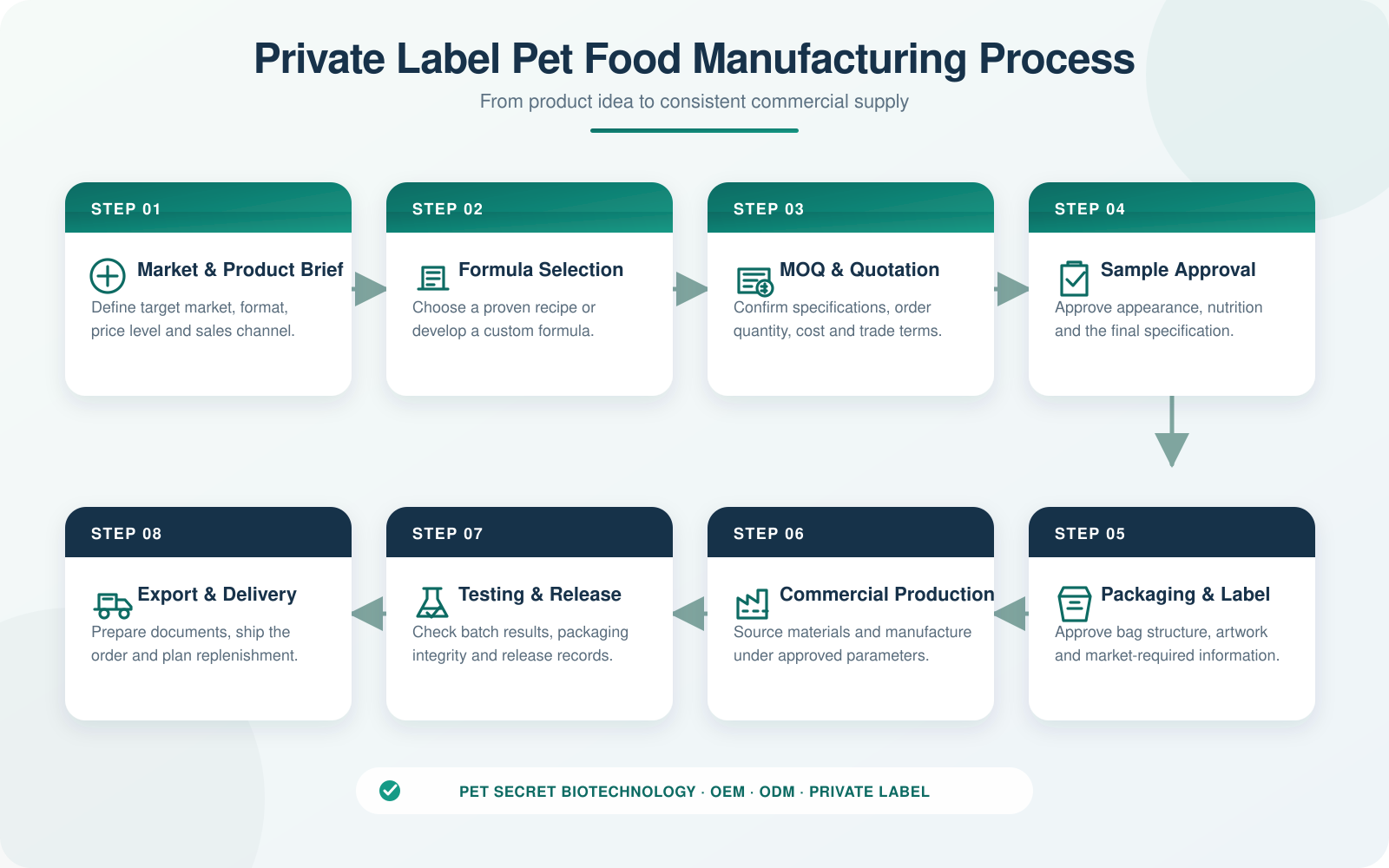
This helps turn a general product idea into a specification that can be manufactured, tested, shipped and reordered consistently.
Frequently Asked Questions
What is a private label pet food manufacturer?
A private label pet food manufacturer produces dog food, cat food or treats that another company sells under its own brand. The manufacturer handles production, while the brand owner manages marketing and distribution.
Is private label pet food the same as OEM?
The terms often overlap. Private label normally uses an existing or moderately adjusted product, while OEM manufacturing can follow a more specific customer requirement. The exact meaning should be confirmed with the manufacturer.
How much does it cost to start a private label pet food brand?
The cost depends on the formula, MOQ, packaging, testing, registration, freight and import charges. A meaningful budget can only be calculated after the product specification and destination market are known.
What is the minimum order for private label pet food?
At Pet Secret Biotechnology, the standard MOQ is generally 5 tonnes per product. Printed packaging may have a separate minimum order.
Can I use my own pet food formula?
Yes, subject to technical evaluation, ingredient availability, production feasibility and nutritional review. A confidentiality or formula-ownership agreement can be discussed before development.
Can I start with an existing formula?
Yes. Selecting a commercially used formula is often the fastest and lower-risk route for a new brand.
Can the formula meet AAFCO standards?
A formula can be developed toward relevant AAFCO Dog or Cat Food Nutrient Profiles. Final label compliance, ingredients, claims and market registration must still be reviewed for the destination market.
Can you manufacture grain-free pet food?
Grain-free formulas can be developed or selected. The choice should be based on the target customer, nutritional design, local demand and regulatory requirements rather than using “grain-free” only as a marketing term.
Can you make high-protein or high-fat dog food?
Yes, within technically workable ranges. High-fat products require careful attention to formula stability, extrusion, surface oil, antioxidant protection, packaging and storage.
Do you provide packaging design?
Custom printed packaging can be supported. The brand owner should confirm artwork, trademarks, legal text, local language and market compliance before printing.
How long does private label pet food production take?
The first order usually takes longer because the formula, packaging and label must be approved. The exact lead time depends on product development, bag production, order size, testing and export documents.
Can I receive samples before ordering?
Existing product samples may be available. Fully customized formulas may require a paid pilot run because ingredients, production setup and laboratory work are involved.
What quality documents can be provided?
Available documents depend on the product and destination. They may include product specifications, certificate of analysis, quality-system certificates, export documents and batch records.
Can you export private label pet food?
Pet Secret Biotechnology is registered with China Customs for export. Import approval, product registration and market access still depend on the rules of the destination country.
How do I begin a private label project?
Prepare the product category, target market, expected price, nutritional targets, package size and estimated order quantity. Then contact the manufacturer for formula and feasibility review.
Start Your Private Label Pet Food Project
A successful private label pet food brand begins with a clear market position and a product that can be produced consistently.
Before requesting a final quotation, define:
- Who will buy the product
- Where it will be sold
- What price the market can accept
- Which nutritional features matter
- How much you expect to order
- Which registrations and labels are required
Pet Secret Biotechnology can support formula selection, customized product development, production, quality control and packaging preparation.
Contact our team to discuss your target market, formula, package size and expected order quantity.
You can also review:
- OEM Pet Food Manufacturing Process
- ODM Pet Food Development Process
- How to Choose an OEM Pet Food Manufacturer in China
- Pet Food Safety Guide
- Farm-to-Bowl Pet Food Manufacturing
- Fully Automated Pet Food Manufacturing
Private Label Pet Food Buyer Resources
Use these guides to move from product planning to a production-ready brief:
- Information needed for an accurate private label pet food quote
- Existing formula vs custom formula comparison
- Private label pet food process FAQ
- Samples, production and delivery FAQ
- Packaging and labeling FAQ
- Formula and nutrition FAQ
- MOQ and cost FAQ
- Export documents and compliance FAQ
- Pet food additives guide